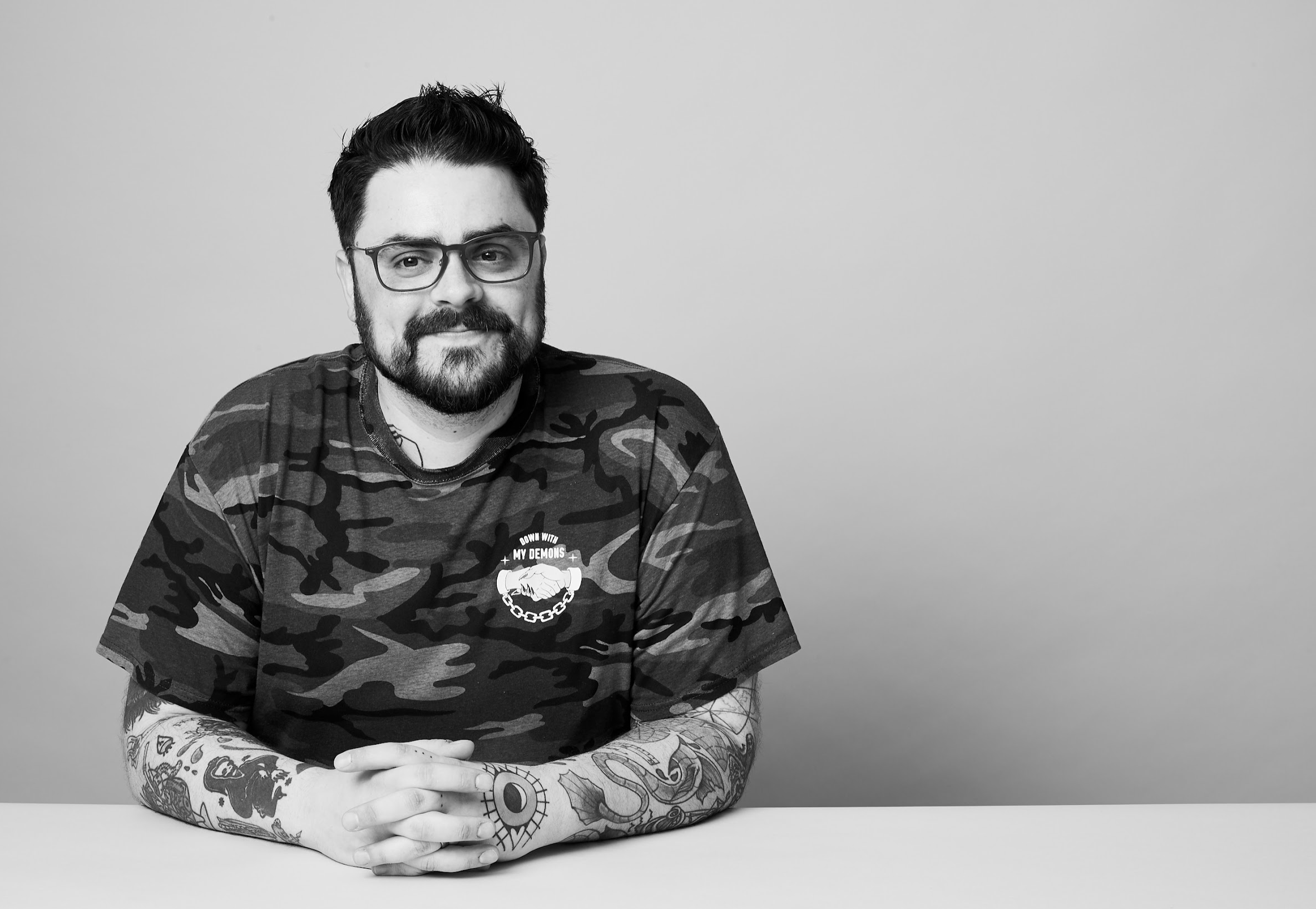
 Justin is currently a Senior Vice President at Newlab. He leads the growth of their network of industry partners as part of Newlab’s mission to accelerate the adoption of deep climate technology in energy, mobility, and materials.
He also sits on the board of the Northern Illinois Food Bank, where he serves on their Innovation Task Force and the Board Development Committee. He splits his time among Brooklyn, Detroit, and a small town in rural Michigan.
Previously, Justin was a partner and Executive Director at IDEO. He led business development for IDEO’s North American consulting business (2021-2022) and was a founding member of Helix, the firm’s internal DE&I leadership team. His client work focused on venture design with an emphasis on strategy, the intersection of data science and design, and B2B products and services. His client included Westfield Insurance / 1848 Ventures, Ergotron, Shure, McDonald’s, Ford, and Jellyvision.
Previously at IDEO, Justin co-led the firm’s effort to explore what data science would mean for design thinking, a project that culminated in IDEO’s acquisition of the Chicago-based data science firm Datascope Analytics in 2017. Post-acquisition, he co-led the integration of Datascope into the Chicago studio and the expansion of data science as a capability across IDEO. In its first full year, IDEO’s data science discipline exceeded its revenue target by 30% and maintained 100% employee retention for 3+ years.
Before coming to IDEO, Justin was the founder and CEO of Food Genius, a foodservice data and analytics startup that was acquired by USFoods in 2016, where it continues to operate it as an independent business unit. Customers included USFoods, McDonald’s, Safeway, Coca-Cola, and Kraft. Food Genius was named to Entrepreneur Magazine’s “100 Brilliant Companies” list and received both a Chicago Innovation “Up and Comer” Award and a Core77 Design Award.
He has been featured on/in NPR’s Morning Edition, Newsweek, The Washington Post, Inc., Restaurant Business, QSR Magazine, and Nation’s Restaurant News and has been a featured speaker / presenter at the National Restaurant Association Show, the Restaurant Leadership Conference, FARE (Foodservice at Retail) Conference, the Food Leaders Summit, NRA’s Innovation Summit, SXSWi, the Produce Marketing Association, and CUSP.
Food Genius was part of the Summer 2011 class of Excelerate Labs, was the first-ever “Startup in Residence” at IDEO‘s Chicago studio, and was the first company to “graduate” from 1871. Justin has been named to the Crain’s Chicago Business Tech50 list (2012) and Chicago’s Food & Drink 50 (New City, 2013). Food Genius was the winner of Ad Age’s “Brand Hacks” on behalf of the Food Network (2012).
~~~
Early in his career, Justin was a radio DJ, a fair and affordable housing advocate, a kindergarten teacher, and an undercover civil rights researcher (although not all at the same time).
Justin was the Director of Project and Grant Development at the Metro Chicago Information Center (MCIC) and a the co-founder and executive director of MoveSmart.org, an organization that connected housing seekers to neighborhoods of opportunity and diversity. While at MCIC, Justin instigated the Apps for Metro Chicago competition, one of the earliest civic data competitions. In 2009, he was named one of the “35 Under 35″ emerging civil rights leaders in Chicago by the Community Renewal Society.
From the spring of 2009 through February 2010 Justin was the Program and Technical Coordinator at NetSquared, where he managed internal communication and helped run innovation competitions. Before that, he was the Fair Housing Testing and Outreach Coordinator for the Chicago Lawyers’ Committee for Civil Rights Under Law. There he supervised the testing program, handled intake and investigation, and conducted fair housing trainings for 3.5 years. At the Lawyer’s Committee, his work focused on the intersection of fair housing and technology and he the led the investigation into craigslist’s publication of discriminatory advertisements, helping create the model for pursuing complaints against creators of discriminatory online housing ads.
Prior to working in fair housing, Justin was a Chicago Public School teacher (8th and 3rd grades) for two years and a research analyst for the Center for New Community for four years. At the Center, he monitored white nationalist activity and trained more than 5,000 young people on how to spot and respond to hate. While at the Center, he wrote for Fellowship, Intelligence Report, and Searchlight magazines and appeared on CLTV, VH1, and NPR’s “All Things Considered”.
Justin holds a BA in Political Science, with a minor in Womens’ Studies, from Loyola University of Chicago and a MA in Teaching from National Louis University. He completed the Fair Housing Accessibility FIRST training and NFHA’s Fair Housing School. He helped organize meetings of Illinois Data Exchange Affiliates and was a founding co-covener of Chicago Net Tuesdays. He used to pitch in with the Open Gov Chicago meetup and is the founder of Urban Geek Drinks.
From 1998 through 2002, he was the co-host of Government Music on WLUW, 88.7fm in Chicago, a Friday night punk and hardcore radio show. During the same time he co-founded and ran a record label of the same name, releasing one great and one truly amazing record.
photo taken by Nico Zurcher in 2019